Shape your career journey with diverse roles and experiences that expand your expertise, feed your curiosity, and fuel your passion.
By Adam Ugolnik
Throughout his childhood, Mark Waki wanted nothing more than to become a fighter pilot. With those dreams crushed due to poor eyesight, Waki was lost, searching for any opportunity to build a life around his greatest passion — military aircraft. A talented painter and model builder who grew up idolizing model box-top artists, Waki heeded the advice of a fellow model builder: he enrolled in art school and went on to become one of the most technically accurate aerospace artists of this time. Thirty-eight years after starting his first job, and with the most replicated painting of the Space Shuttle under his belt, I spoke with Waki about his life, career and opinions of the changing landscape of art in today’s aerospace industry. This piece has been edited for clarity.
Adam: Have you always been talented in the arts? Did that come naturally, or was it something you had to work at as a kid?
Mark: I started drawing when I was really little, so the art classes I took — they were effortless. Whenever I did any kind of assignment, the instructors would ask if I’d done them before. Whether it’s a talent, I don’t know. I always felt it was hard work.
Adam: Can you walk me through your creative process? Are you sitting down with an engineer who’s explaining to you what they’re looking for? Do they tell you about the product and you envision what it looks like?
Mark: It starts with the pilot. Most everything I do is a scene — with an airplane, it’s a combat scene. So, I talk to people who fly that type of mission. Then I think about how to create the scene so it’s technically accurate. If it’s possible to make it completely accurate with separations between airplanes and altitudes, then that’s what I’ll do. Of course, there are times when it’s impossible to put everything in the right view and make it technically accurate, so I’ll take artistic license and adjust things.
Adam: Do you sketch it small and then share that with them?
Mark: Yes. Initially, before computers, I would do 4 x 5 inch small oil paintings. I would do a bunch of those, and they would say, “I like this view a little better than that view, so let’s do that.” Now I do it all in Photoshop. Which, in a way, makes it tougher because Photoshop is so easy that I can do endless numbers of small compositions. So now it’s like, “I like this one, and I like this one and I like that one too.”
Adam: As a kid, what sparked the interest in planes? What was the catalyst to all of this?
Mark: You know, I can’t really pin that down. I remember there was an airshow in the early ’60s. That probably really set it off, but I’ve always had an interest in things that fly.
Adam: In your bio, you mention some of your favorite box-top artists — I’m curious how you came to discover them.
Mark: Well, in addition to the drawing, I was also an avid scale modeler when I was young. My parents bought me a plastic airplane kit around the same time I started getting interested in airplanes. They would get me kits of everything ... cars, tanks, airplanes, monsters ... I liked anything to do with models, but I liked airplanes the most.
Jack Leynnwood and John Steel were model box-top artists, so I would see their work on the box tops and I thought they were the best. But I discovered Keith Ferris near the end of high school. Keith would do ads for Chandler Evans and other companies in Aviation Week. I thought Keith was actually a step up because he was technically correct, whereas Steel and Lynwood didn’t need the technical accuracy because they did box art.
Adam: You had planned to become a pilot, I understand, but were limited by your eyesight. I’m curious how old you were when you discovered that your eyesight would impact this aspiration.
Mark: It was between my junior and senior years of high school. We were going through my possible career paths. I looked at every possibility and just knew that I wasn’t going to fly military planes. I was always good at math and science, so I decided to pursue an engineering degree, but I couldn’t pin down what I wanted to do. I was lost.
Adam: You attended University of Utah, and Utah Technical College ... what were your expectations at that time?
Loading component...
But I was in this model airplane club, and one of the guys in the club was an art instructor at Utah Technical College. I would sketch stuff and bring it in for the guys to see, and he said to me, “You need to go to school. You have talent!” So I went to technical school.
Adam: Did you enjoy that? Did you embrace the training?
Loading component...
Adam: So how did you fall into your current position?
Loading component...
Adam: What were your first impressions when you started? Was it a big adjustment for you?
Mark: You put a lot of effort into artwork or a model, but things changed so quickly, the old “don’t get attached to your work” saying really applied. What was current one day wasn’t current two weeks later. You had to constantly put work behind you and move on to the next thing. That was a little hard to get used to.
Adam: What were some of the very first projects they put you on?
Mark: I started right when the shuttle was brand new. I think it was a year and a half after the first flight, so it was mostly shuttle models.
Adam: Tell me what that was like for you ... You had grown up so fascinated with airplanes, and here you are, working on this next-generation spacecraft.
Mark: You know ... It was really interesting. The model building and the painting were second nature. But learning about the hardware made it the most interesting because I got to talk to the engineers and see drawings of the real hardware. And then get to go look at it.
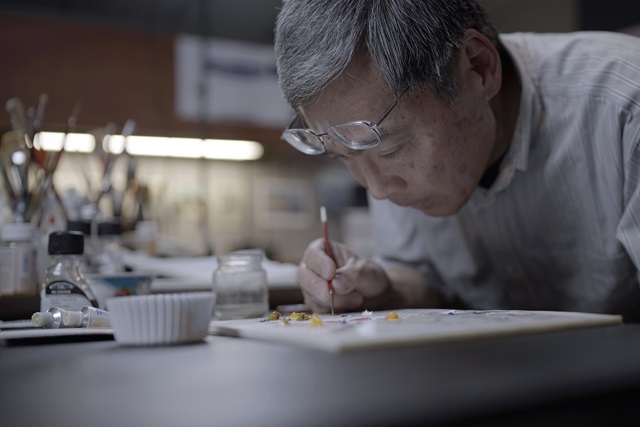
Adam: What was that transition like from traditional painting and models to more computer-centric techniques? Did you get ahead of it? Were you training on computers, or was it just a sort of gradual evolution?
Mark: Digital illustration and computer-generated stuff was really interesting to me, so I jumped into it early. I spent a lot of time on it at home on my own time.
Adam: Tell me some of the greatest challenges that you’ve encountered.
Loading component...
Adam: What are some of the challenges you encounter on a day-to-day basis?
Mark: Lack of time. Before the customer comes to you, the deadline is already relatively close, so the working window is short. As I’ve worked here longer, that’s become less of a problem. But for model work and digital work, the working window is always extremely short. Improving your technique or knowledge of how to do things fast is extremely valuable.
Adam: You’ve been doing this 38 years now. How do you stay motivated and keep that flame lit?
Mark: I’m always looking at master painters, and there is still so much to learn. I feel like I need another 20 years to become a good painter. Aviation art and aerospace art will never be considered truly fine art, so I think my motivation is to inspire our fighter pilots, inspire our astronauts and inspire our engineers. To keep them interested, it’s got to be technically accurate.
Adam: Where do you see things going as far as the positions that artists hold within the aerospace industry? Do you see a continued need for artists?
Loading component...
Adam: If you’re painting a car, you can walk around it and look at it from different angles and perspectives. But when you’re painting a space shuttle launch, you really have to know what you’re doing.
Mark: I guess I’m lucky my brain works that way. When I put three-dimensional objects in space, I can picture how they look and can figure that out. The things you can do with paintings to give depth — bright and dull, warm and cool, light and dark ... Most digital artists don’t get those three primary things.
Adam: How many people with your skillset are you working with?
Mark: None.
Adam: So you’re the guy? That’s a lot of pressure on you.
Loading component...
I think someone with an engineering background who has interest in producing art would be better served pursuing this. R.G. Smith was a full-blown engineer. He designed parts for the A-4 Skyhawk and everything. His artwork was on the side, but pretty soon, all the company executives started to say, “Hey, we’ll make you a painter.”
Adam: What would you say to those artists or engineers, just starting out, who might want to do what you do?
Mark: Maybe it’s a result of my parents’ generation and what they instilled in me, but I’d say, “Pursue what you want to do, and never give up. If you run into a hard spot, you just have to keep going.”
Adam: Did you meet a lot of those hard spots?
Mark: Yeah. There were a lot of tough spots. Just had to keep going.
Adam: What’s in your future? What do you look forward to doing in retirement?
Mark: I look forward to painting more. I have a list of about 50 airplanes I want to paint.
Northrop Grumman employees apply their talents in all areas of the business, including photography, design, communications, engineering, manufacturing, physics and more. Find out about open positions where you, too, can be creative and innovative.