Measuring Elementary Particles
Jerome Luine is on a mission of the quantumphysical kind.
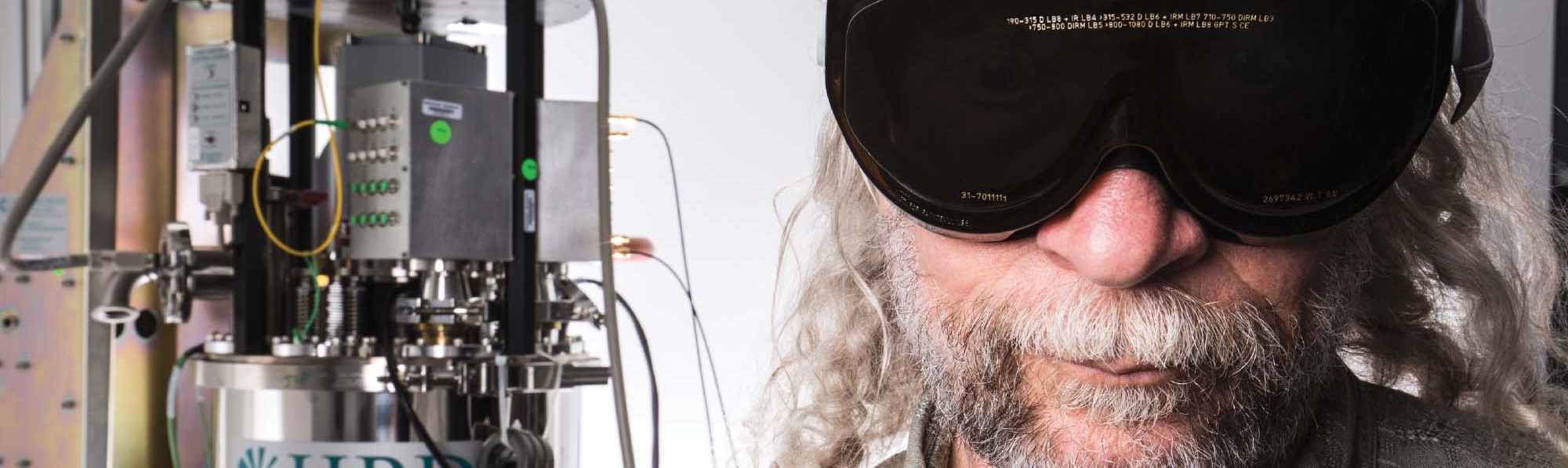
Jerome Luine is on a mission of the quantumphysical kind, and he’s collecting elementary particles theorized by one of the most famous scientists of our time, Albert Einstein. As the principal scientist and group lead for Quantum Sensing and Metrology Basic Research at Northrop Grumman’s NG Next lab, Luine works with a revolutionary piece of equipment called a transition edge sensor, or TES. This particular TES counts photons — however, unlike other photon counters across the world, this one doesn’t “go blind” or shut down after the first particle arrives. It can count multiple photons coming in at the same time.
“We want to directly measure whether one, two, four or 10 photons arrive,” said Luine, a 36-year veteran of Northrop Grumman. “There are other ways of determining that number, but this is the most straightforward method.”
To verify the number of photons coming into the TES, a tiny piece of tungsten measuring 20 microns by 20 microns by 20 nanometers — that’s as small as the thinnest human hair — is carefully suspended within the super-cooled device. The TES operates at just .05 degree above absolute zero. “It’s a thermometer in reality,” Luine said.
When a single photon hits the tungsten, the tungsten’s temperature goes up only slightly. When two photons hit the chemical element, its temperature rises proportionally. If four photons enter the tungsten, its temperature rises even more, and so on. In this way, researchers can determine the number of photons that arrive.