By Morgan Frazer
In the world of aviation, advanced technology solutions don’t usually grow on trees, however, that’s how engineers at Northrop Grumman’s Rancho Carmel campus in San Diego found their answer hiding in plain sight.
The secret? Home-grown cactus needles.
While not exactly a tree, the prickly cactus plant sparked a cutting-edge idea to fine-tune high-tech avionics for one of the most advanced aircraft in the sky – the F-35 Lightning II.
“Our team was looking for ways to reduce production space and reliance upon suppliers while driving down cost,” said Tony Bellora, electrical engineering manager on the F-35 Communications, Navigation and Identification (CNI) program. “We taught ourselves how to design, build and test the microelectronics ourselves. Essentially, we became the Swiss watchmakers of aviation.”
Sharp Solutions
The F-35 is a stealthy, supersonic, multirole fighter for the United States and international partners. Northrop Grumman plays a key role in the development, production and full lifecycle modernization and sustainment of the F-35, including the center fuselage, radar, electro-optical infrared imagery, upper wing skins and access covers, weapons, and the CNI. The company does about 40 percent of the work on the F-35.
The F-35 CNI is an integrated avionics suite, combining more than 27 avionics components into a unified, cohesive system that work seamlessly together. Built using software-defined radio technology, the CNI components are made up of filters with microchips and tiny metal coils that must be meticulously, delicately tuned to communicate across a variety of radio frequencies and bandwidths.
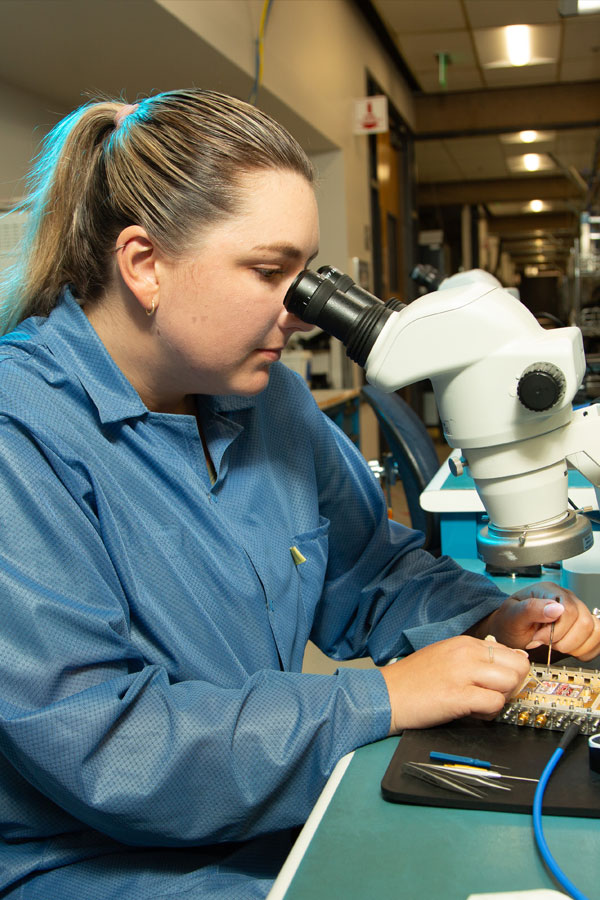
While the CNI team uses automated manufacturing to build the filters, the tuning process still requires a human hand. Technicians perform microscopic adjustments during testing, much like the intricate mechanisms of a Swiss watch. For these precise adjustments, a thin, durable tool was required — but the team was having difficulty pinpointing exactly what tool to use.
“We tried toothpicks, bamboo, even metal,” said Tony. “All of these items splintered and created foreign object debris within the system, rendering the CNI inoperable.”
A Delicate Touch
While on a road trip to Arizona many years ago, Tony’s mind was buzzing: the team needed a more durable solution to tune the CNI filters. After seeing miles upon miles of cacti, he pulled over to get a closer look. He bent down to examine the needles blanketing the desert floor, sparking the idea to try one of the fallen needles in the tuning process once he returned to work.
The idea was both simple and revolutionary. Little did he know, this chance encounter would blend nature’s ingenuity with an innovative way to solve real-world challenges.
Tony brought a few needles into work to test out his theory. The rest of the team was in disbelief – how can a cactus needle be the solution?
Unlike traditional tuning processes which rely on complex calibration tools and materials, Tony discovered that cactus needles provided a natural, biodegradable alternative with unique advantages. Their inherent non-conductivity, durability and fine points allow for precise adjustments to be made during the tuning process, ensuring optimal performance with minimal ecological footprint.
“The strength and precision of the cactus needle allows us to safely test the filters so we can deliver quality radios to our customers,” Tony said. “With this creative approach we can leverage existing resources in a responsible, sustainable way.”