Pioneering Technology for Space Deployable Structures
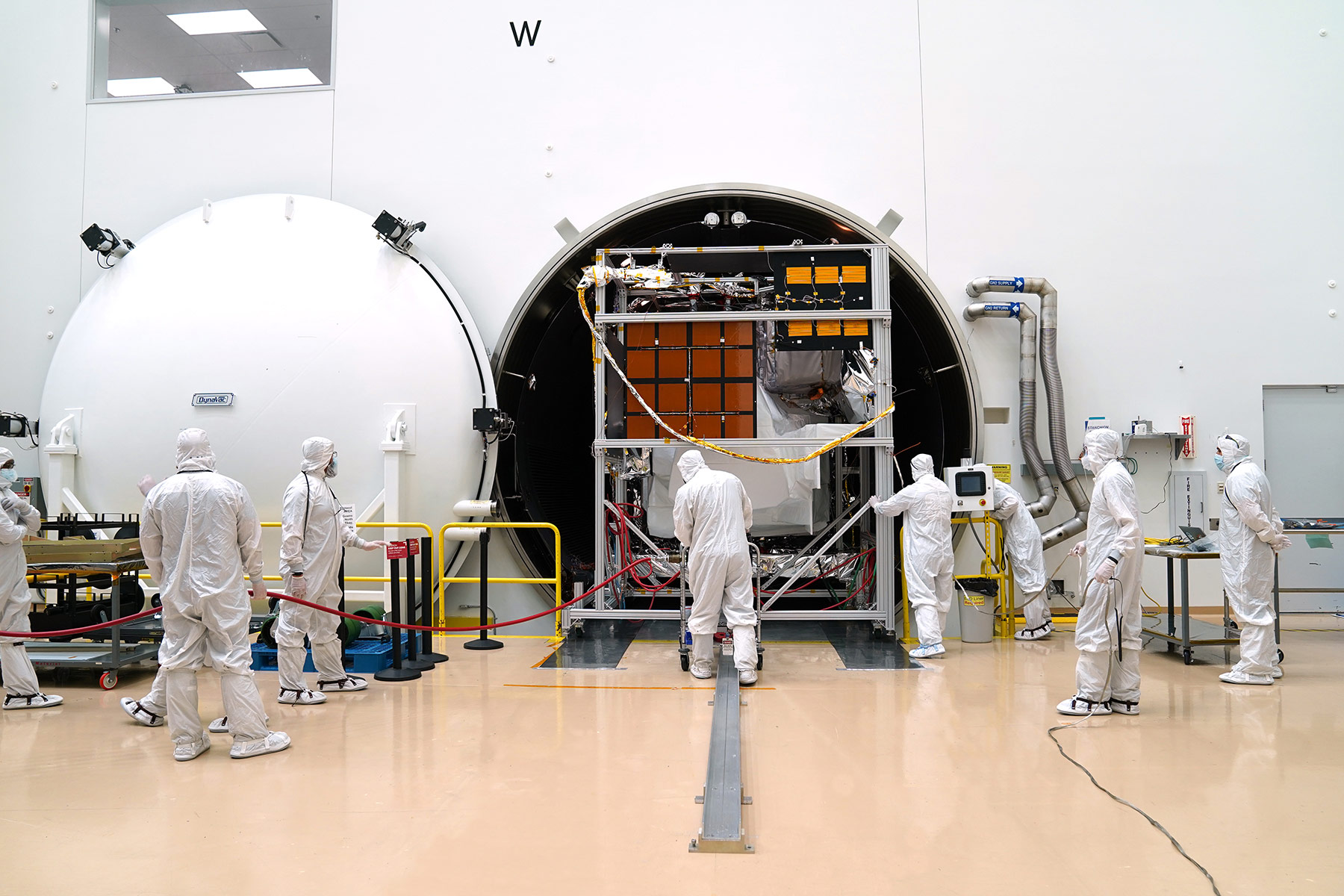
While space deployable structures are now commonplace in interplanetary exploration, the Mars Advanced Radar for Subsurface and Ionosphere Sounding (MARSIS) antenna team pioneered the technology for this mission.
Geoff Marks, lead technologist for MARSIS recalled, "Our customer provided us with the required thickness and length of the radar antenna, then asked us to come up with an idea for how to fit it in the spacecraft, then deploy it in space."
Because the antenna was built for a low-frequency radar, it had to be 40 meters long once fully deployed in orbit. The problem? It needed to be around 1.5 meters in length while in transit and able fit on the side of a spacecraft the size of a subcompact car.
Fortunately, the team had some arrows in their deployables quiver. Since 1958, Astro Aerospace had been pioneering the technology of space-deployable structures — devices that can be dramatically reconfigured once in space.
For MARSIS, the team designed a lightweight space deployable dipole antenna using two 20-meter booms or poles, which collected information by sending radar pulses to Mars' surface and receiving pulses in return. A third, shorter boom eliminated interference between real signals and possible scatter, acting like a massive set of rabbit ears on old television sets.
The most innovative aspect of the design was a new concept created by Marks, called foldable-flattenable-tube (FFT) booms, which enabled the antennas to achieve full stow shrinkage. FFT booms are like the cardboard tubing inside paper towel rolls: long, light and thin-walled. This allows them to support the full length of the antenna's electrical elements and — with some ingenious engineering — fold.