Gathering the Essentials, Including a Northrop Grumman Invention
To make the concept work, however, Theobald's team also needed a way to transfer stored energy efficiently and reliably from the station to rechargeable autonomous systems, as well as a way to transmit mission data quickly and securely from the undersea platform to a waiting satellite, ship or ground station.
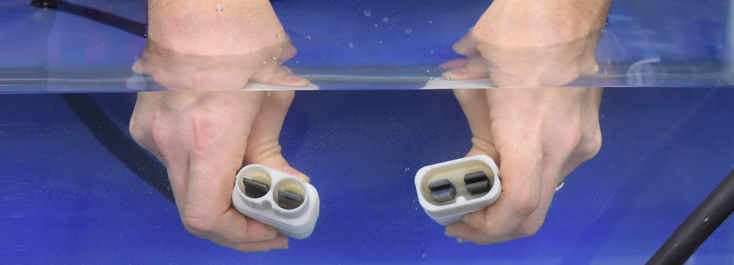
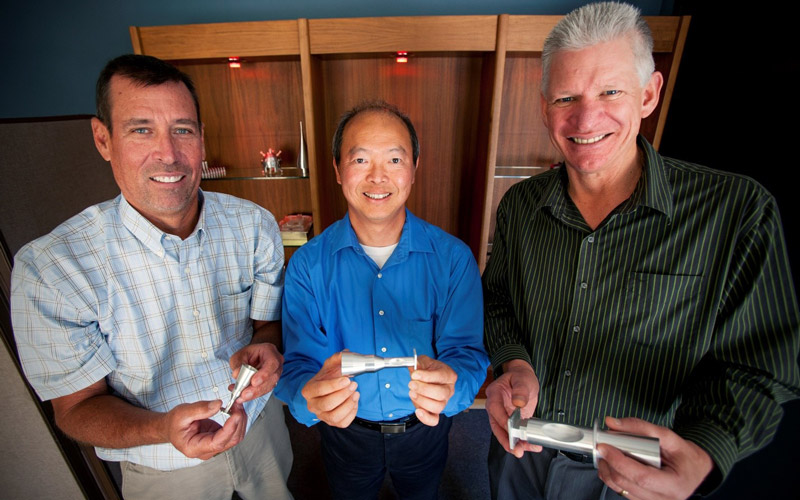
To solve the first problem, the team drew on NiobiCon™, a revolutionary, self-insulating electrical connector technology invented by Northrop Grumman senior staff engineer Jim Windgassen and Northrop Grumman Fellow Harvey Hack. NiobiCon™, which can be mated and de-mated while fully exposed to water, completely upends the traditional paradigm of using rubber seals or oils to exclude water from underwater connectors.
The success of NiobiCon™, explained Windgassen, derives from the unique properties of the element niobium.
"When niobium contacts water, it instantly forms a very thin, passive film that serves as an insulator," he said. "The film prevents current from leaking from the contact into the water. When the connector's two halves are mated, the insulating film is scraped off, allowing current to flow unimpeded through the connector. When the connector is disconnected, the insulating film instantly reforms on its contacts, which prevents any life-shortening corrosion of the contacts."
Anchoring the Concept
Consistent with the Blue Economy competition, the Mission Unlimited UUV Station currently exists as a paper concept only. As Theobald envisions it, however, the station would be deployed from a ship, sink to the bottom and then anchor itself.
"Once in place, its thermal energy harvesting pod will begin propelling itself up and down a cable through the thermocline, generating and storing electricity," he explained. "Within a few days, it will have generated enough energy to begin servicing autonomous rechargeable systems."
UUV will be able to dock with Mission Unlimited UUV Station, recharge themselves and offload mission data without having to surface, added Theobald. The transfer of both data and electricity will be handled by a single copper cable outfitted with a NiobiCon™ connector. The UUV will mate to that connector with its own NiobiCon™ connector.
Floating to the Top: Data Bubbles
To transmit mission data from the undersea station to a satellite or ship, Northrop Grumman plans to use a proprietary data transfer technology called data bubbles.
"Data bubbles are tiny electronic devices that store data," explained Theobald. "When released from the station, they float to the surface and begin using their RF satellite communications antenna to transmit data to shore, to a satellite or to a ship."
In April, NOAA and DOE awarded the Mission Unlimited UUV Station one of ten "Explorer" prizes for the "Discover" stage of the "Powering the Blue Economy" competition. Northrop Grumman and Seatrec expect to enter the "Develop" stage to design, build and demonstrate their station concept for additional prize money.
"The Mission Unlimited name probably sounds like some marketing catchphrase," observed Theobald, "but I actually think it has great relevance to what we're trying to achieve, namely harvesting energy from the environment and using that energy and innovations like NiobiCon™ to extend ongoing underwater missions. Our Mission Unlimited UUV Station could be a game-changer for anyone who uses a UUV.